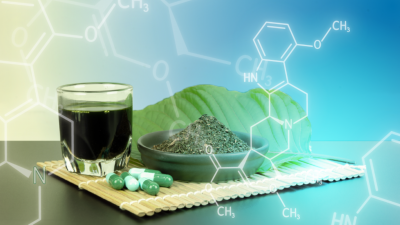
A new laboratory study from Thailand offers a useful starting point for anyone trying to make sense of the vocabulary around kratom products. Published in June 2026 in the journal Molecules, the research by a team from Silpakorn University’s Faculty of Pharmacy and Mahidol University measured how much mitragynine and 7-hydroxymitragynine (7-OH) ended up in kratom extracts depending on which part of the plant was used, where it was grown, and how the extract was made.
The study does not settle every question about kratom chemistry, and it was not designed to. But its findings help explain why terms such as “natural leaf,” “extract,” “enhanced,” and “7-OH product” describe meaningfully different things, and why readers benefit from knowing which one a product, a news story, or a policy proposal is actually talking about.
Start with the plant itself. Kratom (Mitragyna speciosa) is a tree native to Southeast Asia, and its leaves have traditionally been chewed, brewed, or dried and ground. Leaf kratom contains a range of alkaloids, the naturally occurring compounds researchers study for their effects. The most abundant is mitragynine. Another, 7-hydroxymitragynine, is present in much smaller amounts.
The U.S. Food and Drug Administration describes this balance plainly on its kratom information page, stating that 7-OH “is a naturally occurring alkaloid in the kratom plant, but only a minor constituent that comprises less than 2% of the total alkaloid content in natural kratom leaves.” The agency also notes that 7-OH shows “substantially greater mu-opioid receptor potency” than mitragynine. That combination, a compound that is scarce in the leaf but potent in the laboratory, is the reason 7-OH terminology matters so much.
The Thai researchers used a validated high-performance liquid chromatography method to quantify both alkaloids in extracts made from kratom leaves and shoots collected from northern and southern Thailand. They compared two ethanol-based extraction techniques, ultrasound-assisted extraction and microwave-assisted extraction, each run at 50°C for 15 minutes.
Several findings stand out. First, 7-OH was detected only in leaf extracts. In the shoot extracts, and in samples of one locally known variety, it fell below the method’s detection limit. Where it was found, levels in leaf extracts ranged from roughly 1.9 to 2.7 micrograms per milligram of extract. Mitragynine levels in the same leaf extracts were far higher, ranging from roughly 46 to 58 micrograms per milligram.
Second, shoots contained the highest mitragynine concentrations of any sample, at roughly 75 to 80 micrograms per milligram of extract, even though they produced lower overall extraction yields. In other words, the part of the plant used can change the alkaloid profile of an extract considerably.
Third, geography mattered. Northern samples produced higher extraction yields and more mitragynine, while southern samples showed relatively higher 7-OH levels. Fourth, the choice between the two extraction methods made little difference; the authors described the differences between them as “minimal.”
Taken together, the authors concluded that “intrinsic plant-related factors—particularly geographical origin and tissue type—are the primary determinants of extraction yield and alkaloid composition in kratom.” They added that the results “highlight substantial phytochemical variability relevant to quality standardization of kratom-derived products.”
These findings map neatly onto the terms consumers encounter. Natural leaf kratom, whether sold as powder, capsules, or loose leaf for tea, is the dried and ground plant material. Its alkaloid content reflects the plant it came from, with mitragynine as the dominant alkaloid and 7-OH present only as a minor constituent.
A kratom extract is made by using a solvent, such as ethanol or water, to pull alkaloids and other compounds out of the plant material and concentrate them. The Thai study is a reminder that an extract is not a single standardized thing. Its composition depends on the starting material, including which plant part and which growing region were used, as well as on how it was processed. Two products both described as “extract” may therefore differ substantially.
Words such as “enhanced” or “fortified” are a looser category still. They are marketing terms rather than standardized scientific definitions, and on their own they do not tell a consumer how much of any particular alkaloid a product contains or how it was made.
Products marketed around 7-OH are a separate category again. Rather than reflecting the leaf’s natural alkaloid balance, they are built around concentrated or synthetically produced 7-OH. The FDA draws this line explicitly. In its guidance on 7-OH products, the agency states that its actions “are intended to target concentrated and synthetic 7-OH products and are not intended to apply to natural kratom leaf containing only naturally occurring trace levels of 7-OH.”
That distinction is at the heart of evidence-based regulation. Treating natural leaf and concentrated 7-OH products as interchangeable can blur the picture for consumers and policymakers alike, while clear definitions allow safeguards such as testing, labelling, and age limits to be aimed at the products they are meant to address.
The study also contains a useful lesson in reading numbers carefully. When a figure about 7-OH appears, it helps to ask what it is being measured against. The FDA’s “less than 2%” figure refers to 7-OH as a share of total alkaloid content in natural leaves. The Thai study reports micrograms of each alkaloid per milligram of extract. Product labels may use milligrams per serving. These are different measures, and comparing them directly without accounting for the difference can lead to misleading conclusions.
The researchers were also candid about the limits of their work. They noted that their HPLC–DAD method “generally exhibits lower sensitivity” than more advanced LC–MS/MS techniques, “which may limit trace-level detection of minor alkaloids such as 7OH-MG.” A result of “not detected” in shoots, then, means below this method’s detection limit rather than a confirmed absence.
They also acknowledged that “part of the detected 7OH-MG may arise through oxidative transformation of MG during plant metabolism, storage, processing, or extraction.” Mitragynine can convert into 7-OH through oxidation, so some of the 7-OH measured in a sample may reflect handling and processing rather than the living plant alone.
The study examined plant material from specific regions of Thailand using two ethanol-based methods. It did not test commercial products sold to consumers, and it did not assess effects in people. Its findings describe what happened under these laboratory conditions rather than what any particular product on a shelf contains.
For readers, the practical value of the research lies less in any single number than in the broader picture it supports. Kratom is a variable botanical. Where it grows, which part of the plant is used, and how it is processed all shape what ends up in the final product. Natural leaf contains 7-OH only as a minor constituent, while products built around concentrated 7-OH are a different category altogether, one that federal regulators have said they treat separately from the leaf.
Understanding those distinctions supports better conversations about kratom, whether a reader is comparing product formats, following a policy debate, or evaluating a claim made online. It also points toward a shared goal for consumers, researchers, and regulators: consistent testing standards and clear, accurate labelling that make it easier to know what a product actually is.